The NSW Education Standards Authority (NESA) has announced new regulations on hate speech for NSW schools that will introduce an explicit prohibition on hate speech by staff in NSW schools. The changes form part of a broader response to recently introduced hate speech and hate crime laws at both state and Commonwealth level and will apply across government and non-government schools. The updated NESA approach is designed to ensure that expectations about staff conduct in schools are clearly articulated and consistently regulated. While schools have long been required to maintain professional conduct standards, the new rules make it clear that hate speech is not permitted and must be expressly addressed in school governance documents. What Has Changed? NESA has confirmed that all registered NSW schools will now be required to prohibit hate speech in their Codes of Conduct for staff. This applies to all people employed by a school, including teachers, administrative staff, support staff and senior leadership. This means that Codes of Conduct, staff handbooks and other governance documents will need to explicitly reference hate speech and make clear that it is not acceptable in any work-related context. The requirement is not limited to classroom conduct and may extend… Read More
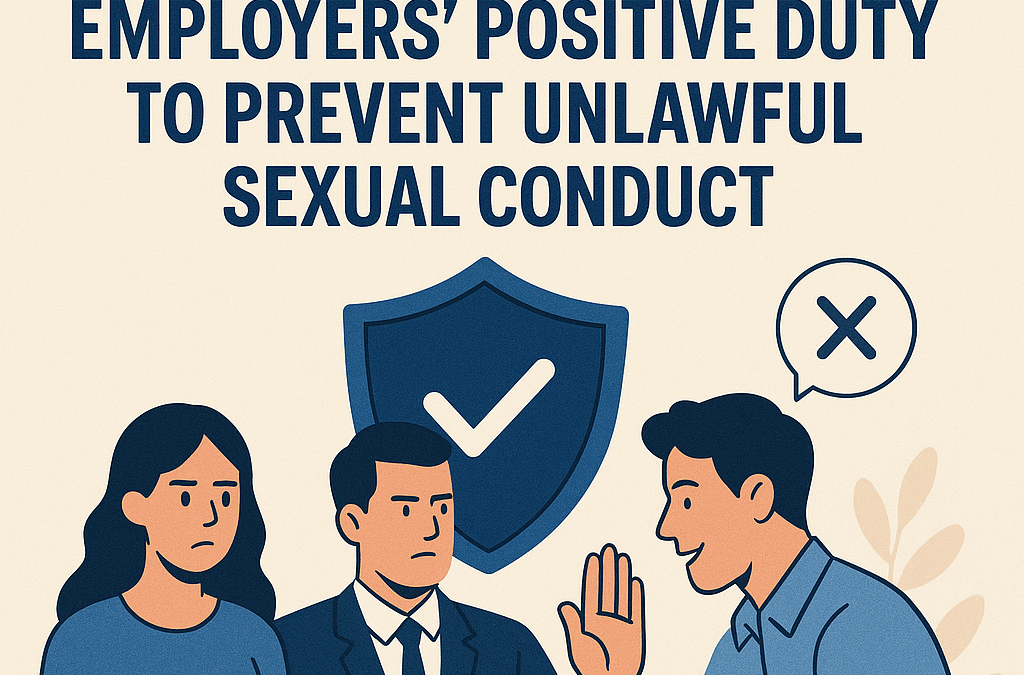
Employers and persons conducting a business or undertaking (PCBU) have a positive duty to prevent unlawful sexual conduct through “reasonable and proportionate measures” under the Sex Discrimination Act 1984 (Cth) (the Act), including: Discrimination on the grounds of sex in a work context Sexual harassment in connection with work Sex-based harassment in connection with work Conduct creating a workplace environment that is hostile on the grounds of sex Related acts of victimisation. This obligation, known as the positive duty, came into effect in December 2022 under section 47C of the Act. It was designed to encourage a proactive approach in the management of unlawful sexual conduct in the workplace.[1] Currently, the Australian Human Rights Commission (AHRC) have the following powers to ensure compliance with the positive duty: Conduct inquiries into compliance. Make findings of non-compliance. Make recommendations to address non-compliance. Issue compliance notices that are enforceable by the federal courts. Enter into enforceable undertakings with employers and PCBU’s.[2] The Speaking From Experience Report: What Does This Mean For Employers? In June 2025, the AHRC published its report Speaking from Experience: What Needs to Change to Address Workplace Sexual Harassment. The report recommended introducing civil penalties for breaches of the positive… Read More
In a landmark decision, the High Court of Australia has expanded employers’ genuine redundancy obligations, confirming that for a redundancy to be genuine, employers must explore all redeployment options, including the possibility of reallocating work performed by contractors to existing employees. This decision serves as a critical reminder for businesses managing organisational change: genuine redundancy requires not just consultation, but a proactive review of how work can be reorganised to retain employees. Background: What Happened at Helensburgh Coal During the COVID-19 pandemic, reduced demand led Helensburgh Coal to scale back its operations, resulting in job losses. While the company consulted with employee representatives, workers urged the business to reduce its reliance on external contractors instead of making employees redundant. Although Helensburgh reduced contractor use slightly, 90 employees were dismissed, and 47 were declared redundant. The affected workers argued that the company could have further reduced contractor work and redeployed existing employees. After a series of Fair Work Commission (the Commission) hearings, it was determined that the dismissals were not genuine redundancies. Helensburgh appealed to the High Court, which unanimously upheld the Commission’s decision. Legal Principles: What Is a Genuine Redundancy? Under the Fair Work Act 2009 (Cth), a redundancy is… Read More
Work Health and Safety Work Health and Safety (WHS) is a critical concern for all Persons Conducting a Business or Undertaking (PCBU). Care must be taken to ensure that your organisation is equipped to mitigate or eliminate risks. For those operating in high-risk environments, the nature of work and the environment present unique challenges and responsibilities. A workplace may be considered a high-risk environment when the nature of the tasks or individuals involved presents a heightened potential for injury or harm, both physically and psychologically. For example, organisations operating in the education and care sectors will face increased risk in respect of vulnerable children or clients they serve. This article focuses on the obligations in NSW under the Work Health and Safety Act 2011 (NSW) and the Work Health and Safety Regulation 2025 (NSW). Similar frameworks operate across Australia, making the practical guidance applicable nationwide. Primary Duty of Care Every PCBU must ensure, so far as is reasonably practicable, the health and safety of all workers. This extends to employees, contractors, volunteers, and anyone else carrying out work. What is ‘reasonably practicable’ will be different in each workplace. Consequently, every PCBU must assess how to ensure the health and safety of all… Read More
UPDATE ON INSTITUTIONAL CHILD ABUSE LITIGATION IN AUSTRALIA Paul Davis – Director Introduction 1 Following the end of the Royal Commission into Institutional Responses to Child Sexual Abuse in 2017, litigation of abuse claims in Australia has continued to evolve, with frequent changes over the recent years generating uncertainty for both claimants and defendants. These ongoing shifts have contributed to significant challenges for all parties involved and, at times, have acted as a barrier to achieving meaningful access to justice. This paper covers some of the recent developments and the practical implications that they have had for claimants and defendants. Major caselaw Bird v DP (A Pseudonym) [2024] HCA 41 2 The case of Bird v DP was one of the significant decisions that marks a significant pendulum swing away from claimants’ interests in recent years.[1] Background 3 The plaintiff, DP, advanced two claims:[2] Firstly, it was argued that the Diocese was vicariously liable for the assaults committed by assaults committed by a priest.[3] Secondly, it was claimed that the Diocese was directly liable in negligence, asserting that the then Bishop failed to exercise reasonable care in his authority, supervision, and control over the priest’s conduct.[4] The trial judge accepted… Read More