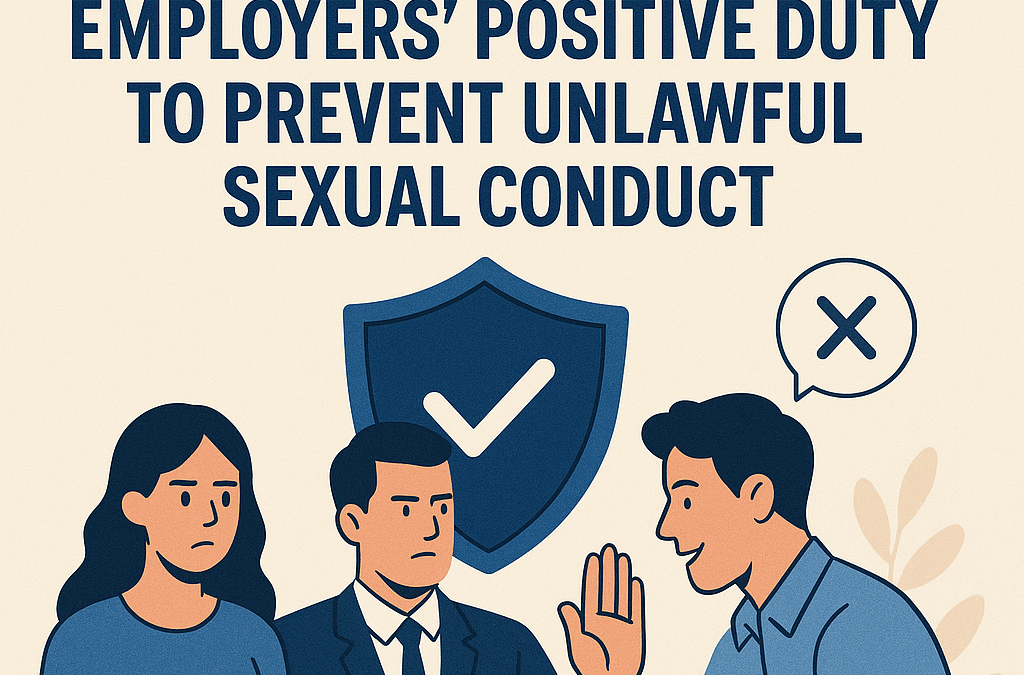
Employers and persons conducting a business or undertaking (PCBU) have a positive duty to prevent unlawful sexual conduct through “reasonable and proportionate measures” under the Sex Discrimination Act 1984 (Cth) (the Act), including: Discrimination on the grounds of sex in a work context Sexual harassment in connection with work Sex-based harassment in connection with work Conduct creating a workplace environment that is hostile on the grounds of sex Related acts of victimisation. This obligation, known as the positive duty, came into effect in December 2022 under section 47C of the Act. It was designed to encourage a proactive approach in the management of unlawful sexual conduct in the workplace.[1] Currently, the Australian Human Rights Commission (AHRC) have the following powers to ensure compliance with the positive duty: Conduct inquiries into compliance. Make findings of non-compliance. Make recommendations to address non-compliance. Issue compliance notices that are enforceable by the federal courts. Enter into enforceable undertakings with employers and PCBU’s.[2] The Speaking From Experience Report: What Does This Mean For Employers? In June 2025, the AHRC published its report Speaking from Experience: What Needs to Change to Address Workplace Sexual Harassment. The report recommended introducing civil penalties for breaches of the positive… Read More
In a landmark decision, the High Court of Australia has expanded employers’ genuine redundancy obligations, confirming that for a redundancy to be genuine, employers must explore all redeployment options, including the possibility of reallocating work performed by contractors to existing employees. This decision serves as a critical reminder for businesses managing organisational change: genuine redundancy requires not just consultation, but a proactive review of how work can be reorganised to retain employees. Background: What Happened at Helensburgh Coal During the COVID-19 pandemic, reduced demand led Helensburgh Coal to scale back its operations, resulting in job losses. While the company consulted with employee representatives, workers urged the business to reduce its reliance on external contractors instead of making employees redundant. Although Helensburgh reduced contractor use slightly, 90 employees were dismissed, and 47 were declared redundant. The affected workers argued that the company could have further reduced contractor work and redeployed existing employees. After a series of Fair Work Commission (the Commission) hearings, it was determined that the dismissals were not genuine redundancies. Helensburgh appealed to the High Court, which unanimously upheld the Commission’s decision. Legal Principles: What Is a Genuine Redundancy? Under the Fair Work Act 2009 (Cth), a redundancy is… Read More