
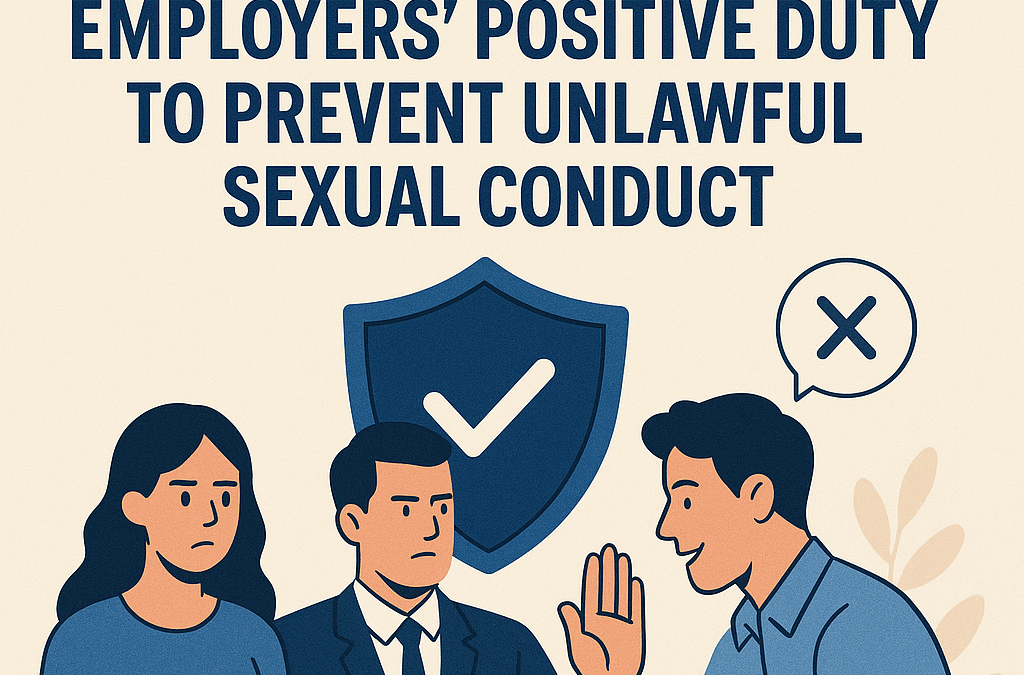
Employers and persons conducting a business or undertaking (PCBU) have a positive duty to prevent unlawful sexual conduct through “reasonable and proportionate measures” under the Sex Discrimination Act 1984 (Cth) (the Act), including:
- Discrimination on the grounds of sex in a work context
- Sexual harassment in connection with work
- Sex-based harassment in connection with work
- Conduct creating a workplace environment that is hostile on the grounds of sex
- Related acts of victimisation.
This obligation, known as the positive duty, came into effect in December 2022 under section 47C of the Act. It was designed to encourage a proactive approach in the management of unlawful sexual conduct in the workplace.[1]
Currently, the Australian Human Rights Commission (AHRC) have the following powers to ensure compliance with the positive duty:
- Conduct inquiries into compliance.
- Make findings of non-compliance.
- Make recommendations to address non-compliance.
- Issue compliance notices that are enforceable by the federal courts.
- Enter into enforceable undertakings with employers and PCBU’s.[2]
The Speaking From Experience Report: What Does This Mean For Employers?
In June 2025, the AHRC published its report Speaking from Experience: What Needs to Change to Address Workplace Sexual Harassment. The report recommended introducing civil penalties for breaches of the positive duty under the Act. If adopted, these changes would significantly expand the AHRC’s enforcement powers and require employers and PCBUs to meet a higher standard in proactively managing work health and safety risks.[3]
Under the proposed framework, failure to comply with the positive duty could attract civil penalties in addition to any damages awarded under common law. Courts continue to set important precedents in this area. For example, in Magar v Khan [2025] FCA 875, the Federal Court awarded $160,000 in general damages for sexual harassment and a further $10,000 for victimisation.
Employers face mounting pressure to effectively manage work health and safety risks. The recommendations outlined in the report underscore the growing level of scrutiny and the tightening regulatory landscape in this area.
How Can Employer’s Mitigate This Risk?
Under section 47C of the Act, employers must take “reasonable and proportionate measures” to eliminate the risk of unlawful sexual conduct.
What constitutes “reasonable and proportionate” will vary depending on the circumstances of the employer or PCBU. Factors considered when assessing compliance with the positive duty include the organisation’s size and resources, the nature and context of its operations, and the practicality and cost of implementing measures.[4]
To support employers and PCBUs in meeting this obligation, the AHRC has issued Guidelines for Complying with the Positive Duty, which outline seven key standards designed to help organisations satisfy their legal obligations under the Act:
- Leadership – Senior leaders are essential in fostering a safe, respectful, and inclusive workplace. They must understand their obligations under the Act and maintain up-to-date knowledge of their responsibilities, including the positive duty.
- Culture – Employers and PCBUs should actively promote a workplace culture that is safe, respectful, and inclusive.
- Knowledge – Employers and PCBUs should provide education and training on respectful behaviour and the prevention of unlawful conduct.
- Risk Management – Employers and PCBUs should adopt a risk-based approach to identify, prevent, and respond to unlawful conduct.
- Support – Employers and PCBUs should ensure appropriate support services are available for workers who experience or witness unlawful conduct.
- Reporting and Response – Employers and PCBUs should offer clear and accessible options for reporting incidents and ensure timely, appropriate responses.
- Monitoring, Evaluation and Transparency – Employers and PCBUs should collect and analyse data to understand the prevalence and nature of unlawful conduct. This information should be used to improve workplace culture and develop effective prevention and response measures. Employers and PCBUs should communicate openly with workers about trends, patterns, and lessons learned.
The Model WHS Laws & Employer Obligations
Employers and PCBUs also have broader responsibilities under the Work Health and Safety Act 2011 (NSW) and the Work Health and Safety Regulation 2025 (NSW), which complement the Model Codes of Practice. They must, as far as reasonably practicable, ensure the health and safety of anyone performing work in any capacity.
WHS laws provide practical guidance to help employers meet their positive duty obligations. Key actions include:
- Proactively identifying hazards through workplace inspections, staff consultation, incident reporting, and maintain risk registers.
- Conducting risk assessments to evaluate workplace hazards.
- Implementing effective controls to eliminate or minimises risks.
- Providing training to employees on relevant hazards and control measures.
- Regularly reviewing and maintain controls to ensure ongoing effectiveness.
While compliance with WHS laws does not automatically satisfy the positive duty, it offers an effective framework for reducing the risk of unlawful sexual conduct and supporting compliance with these obligations.
Need Assistance?
For guidance on how the positive duty to prevent unlawful sexual conduct may impact your organisation, or to receive tailored advice on workplace compliance, please reach out to our team.
Call us at (02) 9181 5001 or email us at [email protected].
Explore our full expertise here: https://integroe.com.au/legal-services/.
References
[2] Australian Human Rights Commission, Statement of Intent, 17 October 2024, 3.